BROWSER SIMULATOR / UNDER THE HOOD
One route to release: the AI workflow behind Teskooano
Separate agent tasks, one combined build and a human shipping decision.
Teskooano’s 2025 prototype stalled. Its creator, tanepiper, credits an October restart with Claude Code and Opus 5.5 with repairing bugs and reworking the renderer. Behind that restart is a concrete integration problem: bringing separate agent tasks into one releasable build.
Tasks get separate sessions and git worktrees. One Composer session merges branches, checks the combined tree and alone may push or deploy. Its command/edit gate rejects whole-tree staging, destructive resets, changes to generated files or applied migrations, and subagent pushes. Review, browser verification, profiling and documentation roles stay separate.
Tanepiper retains pricing, what ships, live payment changes and public posts. These workflow details are the creator’s account; their implementation and productivity effects have not been independently verified. Creator account.
What those changes are meant to serve
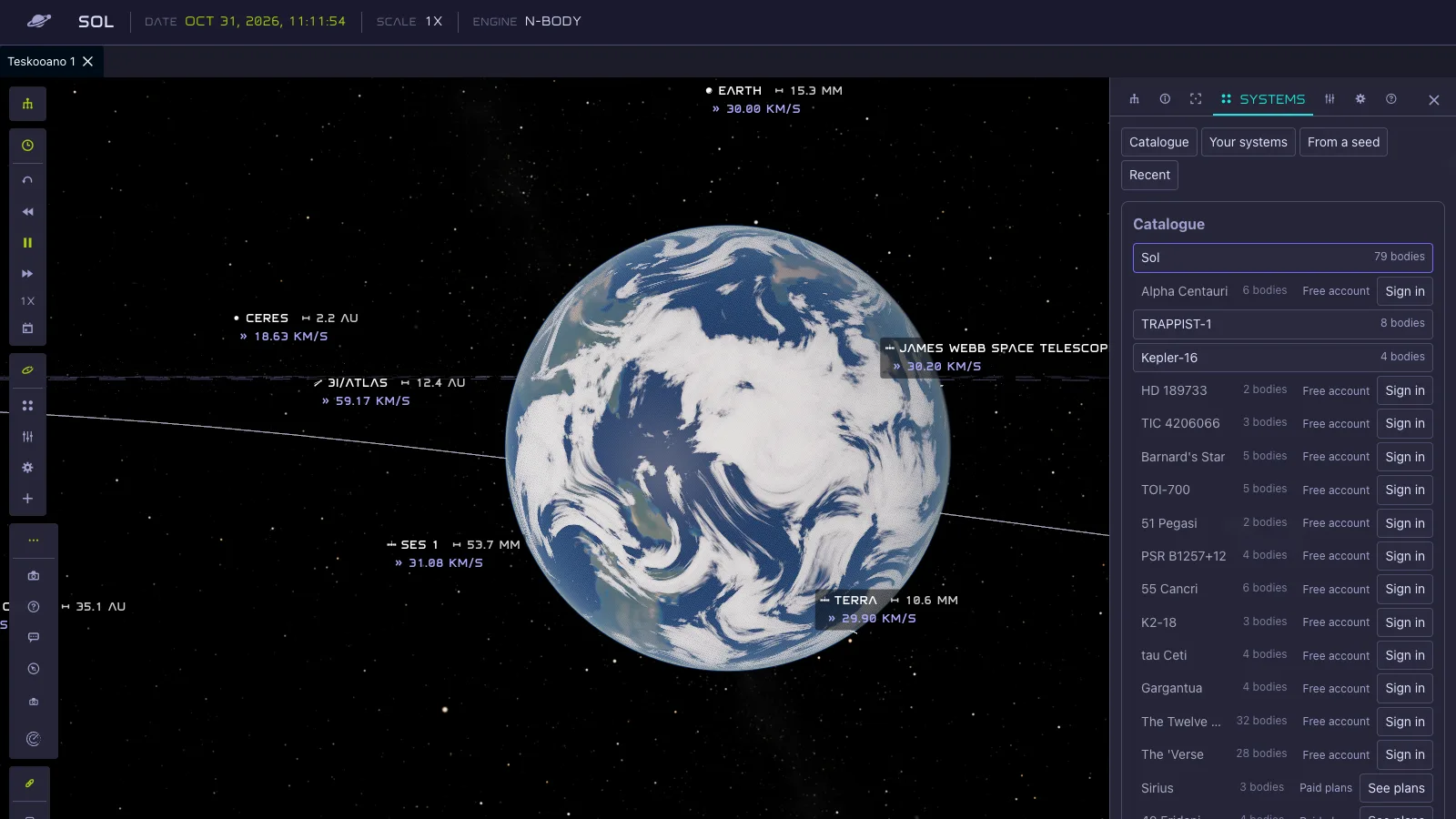
The official release image gives that build a visible destination: Earth covered in cloud bands, with a Systems catalogue alongside it. Some entries carry account or paid-plan labels. Blue Marble release.
Teskooano is a browser N-body simulator. Its website offers named starting points such as our Solar System, TRAPPIST-1 and Kepler-16, with camera tours, focused bodies and multiple views. Deterministic seeds provide another route: the same seed recreates an arrangement of stars, planets, moons, rings or comets. That makes revisiting and comparing a system part of the appeal, alongside simply looking around it. The site also describes every body pulling on the others and an option to switch to ideal Kepler orbits. These offer different ways to examine motion, while a seed gives the arrangement a reference the reader can return to. Official site.
The 31 October Blue Marble announcement describes atmospheres changing the light near a horizon, clouds moving with planetary winds and weather advancing with time. It also brings the Systems tab, editing with undo and redo, saved camera views, photographs and recordings into the app. Editing pauses the simulation; Play resumes it. Those controls put observation and revision in the same space: pause, change a system and watch what follows.
Access is split. Signed out, the product is a free viewer; some catalogue systems ask for a free account. Paid plans advertise room for saved systems, views, tours and recordings, plus larger simulations. The screenshot’s labels make that distinction visible: viewing a world and keeping an expanded workspace are separate offers.
The product’s MCP server is separate from the coding agents in this story. A connected free account can read, analyse and simulate within usage allowances. Creating or editing systems requires a paid entitlement and write permission. The documented tools can provide links to open results in the viewer, connecting a request to something the reader can inspect. MCP documentation.
The link that remains unresolved
The development post links GameFrame for the setup. Its current README describes a framework for reverse engineering games from shipped files. The exact commit or files corresponding to Teskooano’s Composer and gate remain unverified. That leaves a specific gap in the production account; it does not turn the repository link into a reproducible Teskooano setup guide. Current GameFrame README.
The useful unit of progress in this account is a renderer change reviewed in the combined build. That is where separate tasks become one product, and where the human shipping decision has something concrete to judge.